
2 September 2026 by Banana Passion
Yes, for most people. A firm pillow in a waterproof case does what a mid‑range wedge does, at a fraction of the cost, and it can live on your bed instead of stuffed in a wardrobe.
Pillows fail for three reasons: they slide, they soak, and soft ones flatten under body weight. Two of those come down to which pillow you pick. The third is the one you cannot pick your way out of.
A dedicated foam wedge is still better if you want a fixed, steep angle that will not compress at all. That is a real advantage a pillow cannot match.
Purpose-built props that hold a body at an angle: wedges, ramps, cylinders, cube cushions, and the strap and sling accessories that go with them. In Australia, these items run roughly $80 to $400. They all do one job: They change the angle of the hips.
Raising the hips tilts the pelvis. That changes the angle of entry, which for many people is the difference between “fine” and “much better.” It closes height gaps. Two people of different heights line up at a different point when one set of hips is 12 cm higher.
It also does something discussed less often and yet equally important: it takes the work out of holding the position.
Ten to fifteen centimetres under the hips. That is it. Most people massively overestimate this.
One firm standard pillow compresses to about that under body weight. Two pillows stacked gives 20 to 25 cm, which is more than most positions call for. Commercial wedges are typically 15 to 20 cm at the high end, not dramatically more than a pillow you already own.
They do. It just goes poorly, for three reasons:
It slides.
Cotton on cotton has not enough friction. The pillow moves, and someone has to stop and reposition it.
It soaks.
Whatever lands on it goes straight into the pillow. Now it is in the wash, or in the bin, and you’d have to shop for a new pillow.
It flattens.
A soft pillow compresses to nothing under weight. The lift you started with is not the lift you finish with.
Two of these you solve by choosing better. A dense memory-foam or latex pillow is heavy enough to stay roughly where you put it, and firm enough to keep its height. Use the heaviest firm pillow in the house and both problems mostly go away.
The third one you cannot choose your way out of. Every pillow soaks. That’s where a good pillowcase makes a difference!
| PILLOW TYPE | HOLDS HEIGHT | VERDICT |
|---|---|---|
| Memory foam | Excellent | Best. Dense and heavy, so it holds its height and shifts less than a light one. |
| Latex | Excellent | Firm and springy. Very good. |
| Firm polyester fibre | Good | Fine, and you almost certainly own one. |
| Soft polyester fibre | Poor | Flattens under weight. Use two. |
| Down or feather | Very poor | Compresses to nothing. Don’t. |
The rule: use the pillow nobody in the house likes sleeping on. Too firm for a head is exactly right under your hips.
| FOAM WEDGE | FIRM PILLOW + WATERPROOF CASE | |
|---|---|---|
| Lift | 15–20 cm, fixed | 10–25 cm, your choice |
| Holds a steep angle under weight | Yes, nothing beats dense foam | Good with memory foam, less so with fibre |
| Adjustable | No. One shape for life | Any pillow, any height |
| Handles mess | Wipe-clean surface; liquid runs off the sides | Absorbs and holds it |
| Machine washable | Cover only, if it has one | Whole thing |
| Silent | Usually vinyl. Not always | Yes, if the case is fleece over film |
| Can be left in the room | No | Yes. It is a pillow |
| Storage | Needs a cupboard | None. It is already on the bed |
| Replacement cost | Buy new furniture | Buy a new pillow |
| Cost | $80–$400 | A case, plus a pillow you own |

In these 3 cases you’re better off with a wedge:
If none of those describe you, the wedge is likely to end up unused and put away in the attic, out of easy reach.
This is the question that decides whether any of this gets used, and too often, this gets skipped before buying.
A foam wedge looks like exactly what it is from across the room. So it goes in a wardrobe, or under the bed, or back in the box. And a prop you have to go and retrieve is a prop that needs a decision first, which is usually the end of the idea.
Storage is not a minor practicality in this category. It is the whole game. The prop that gets used is the one already within arm’s reach.
The usual answer is a towel, and it is a poor one. A towel covers only part of the area, shifts as soon as anyone moves, and soaks straight through to the sheet.
A wipe-clean wedge is not much better. Liquid sits on the vinyl and runs off the sides, onto the bed.
See there are two problems, not one.
Cover one and you have covered part of it. Cover both and you stop thinking about it, which is the entire point.
Often, yes. Elevation reduces how long anyone has to hold their own weight in a fixed position, and that holding is usually what causes the strain.
If you have a specific back, hip or pelvic condition, or you are pregnant or recovering from surgery, ask your physiotherapist or midwife what is appropriate for you. General advice on a webpage (including this one!) is not a substitute for someone who has looked at your actual body.
A waterproof pillowcase goes in the machine on a warm wash and air or tumble dries on low.
One thing worth knowing: there are two ways to make fabric waterproof. A laminated film, usually TPU, is bonded between layers and survives washing as long as you avoid high temperatures. A sprayed-on repellent finish sits on the surface and washes off after a handful of cycles. This is why so many “waterproof” protectors stop being waterproof, and it is worth checking what you’ll get before you buy one.
A wedge is $80 to $400 in Australia. A waterproof pillowcase is a fraction of that, and the pillow is already in your house.
If you are unsure whether elevation is even for you, the cheap experiment is the sensible first move. Fold a towel over a firm pillow tonight and find out. If the answer is yes, buy the case rather than the furniture.
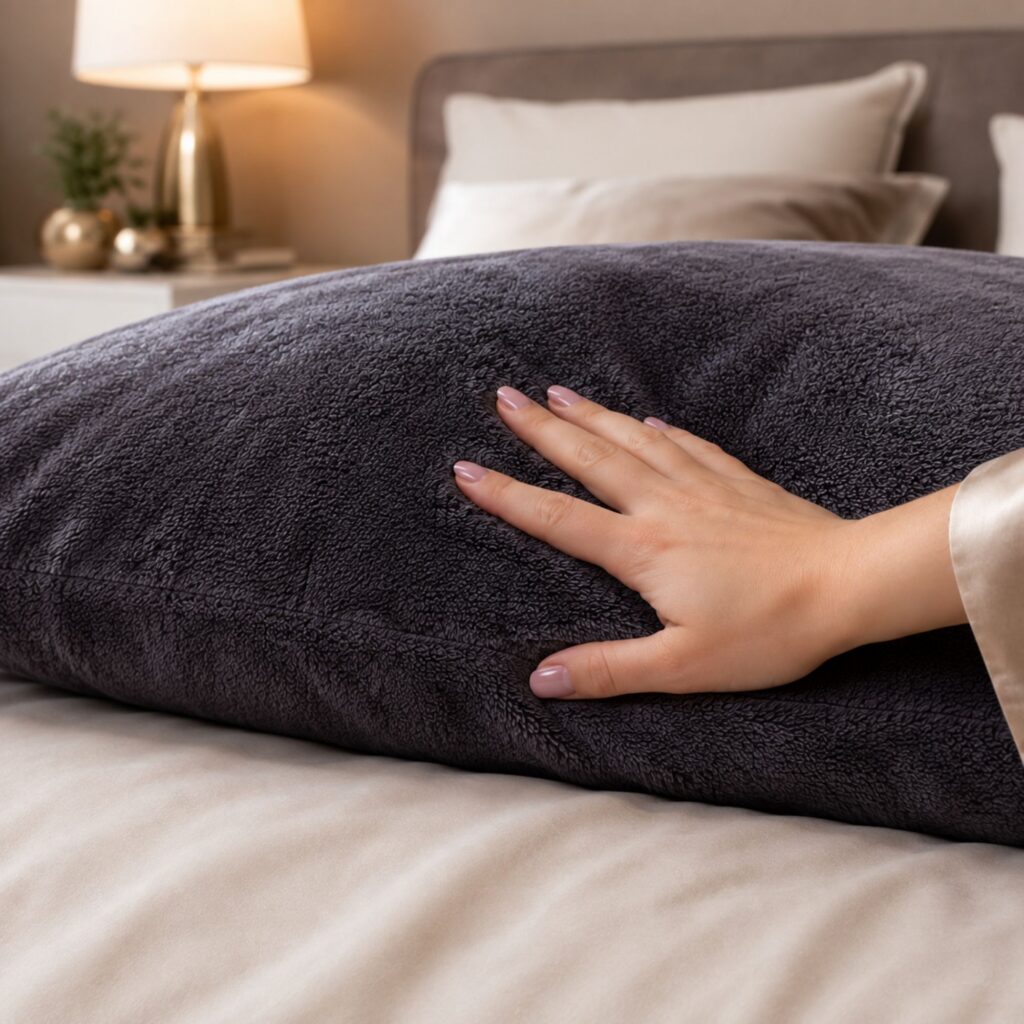
The Waterproof Pillowcase: made of 220 gsm flannel fleece, a laminated TPU barrier and a soft jersey backing. Absorbent, silent, machine washable. Standard Australian pillow: 48 × 74 cm, over any firm pillow you own.
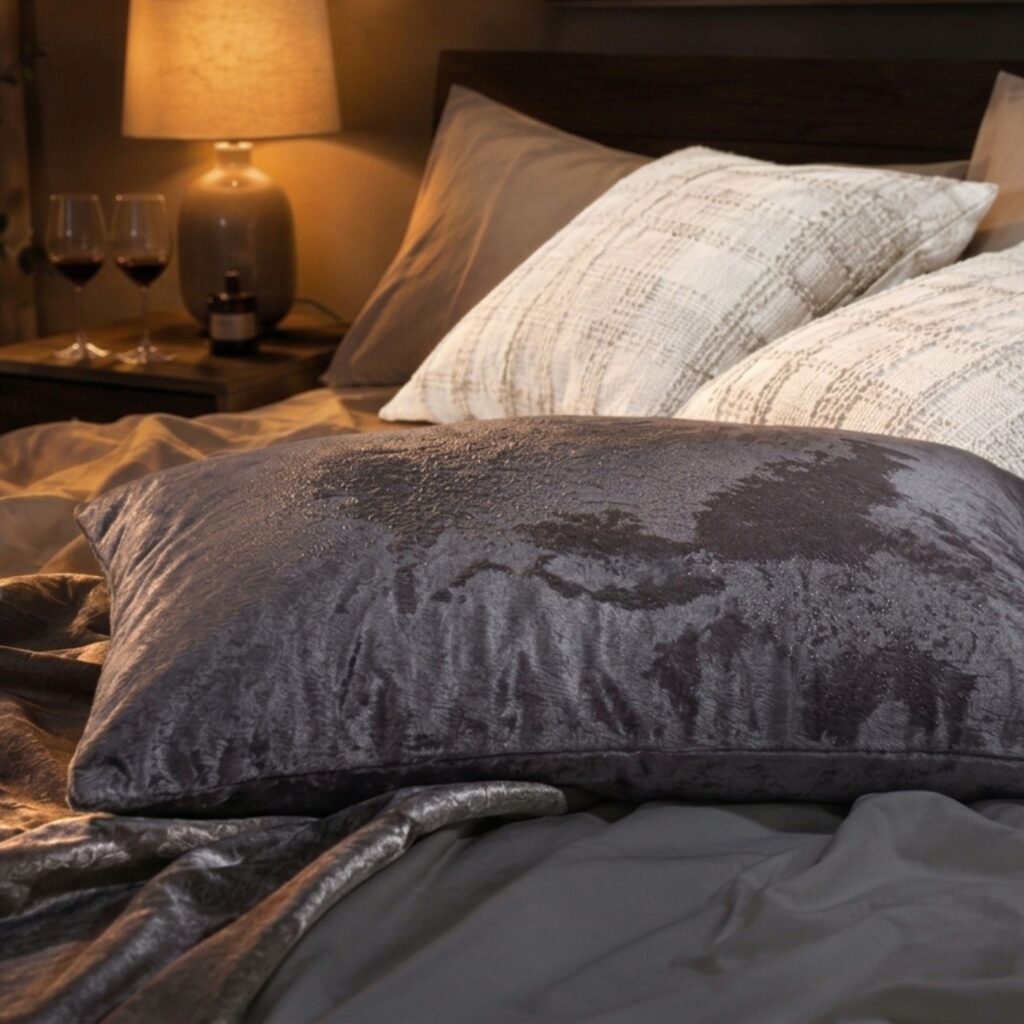
The Velvety Waterproof Blanket: made of 220 gsm flannel fleece (top and bottom), with a PTU laminated barrier inbetween, is a throw big enough to cover the bed. This is the one that catches what the pillowcase cannot.
Yes. A firm pillow in a waterproof case does what a mid-range wedge does for most positions. Pillows fail for three reasons: they slide, they soak, and soft ones flatten under body weight. Two of those you fix by choosing a dense, heavy pillow. The third – soaking – you fix with the case.
Ten to fifteen centimetres under the hips is enough for most people. One firm standard pillow compresses to roughly that. Two stacked gives 20-25 cm, which is more than most positions need.
A firm, dense one – polyester fibre, latex or memory foam. Use the pillow nobody in the house likes sleeping on: too firm for a head is exactly right under hips. Avoid down and feather, which flatten to nothing under weight.
It is if you want a fixed, steep angle that does not compress at all, and you have somewhere to keep it. It is not if it ends up in a wardrobe, which is where most of them end up within a month of purchase.
Treat it as two problems, not one. The pillow is covered by a waterproof pillowcase. The bed is not – and that is where most of it actually lands, so it needs a waterproof blanket or throw laid over the sheet. A towel covers a fraction of the area and soaks straight through. Cover both and you are done.
That is the real problem with it. A foam wedge is too obviously what it is to leave in the room, so it goes in a wardrobe or under the bed – and a prop you have to retrieve is a prop you stop using. A pillow stays on the bed in plain sight.
Often, yes – raising the hips reduces how hard the receiving partner has to hold a position, which is what usually causes strain. If you have a specific back, hip or pelvic condition, or you are pregnant, ask your physiotherapist or midwife what is appropriate for you.
Machine wash warm and air or tumble dry on low. A laminated TPU barrier survives normal washing; a sprayed-on water-repellent finish does not, which is why so many protectors stop working after a few cycles.
