
25 May 2026 by Banana Passion
The short answer: Couples massage at home, even fifteen minutes each, once a week, is one of the most underrated things people can do for their relationship. It releases oxytocin, slows both nervous systems, and creates a regular ritual of being touched without an agenda. It doesn’t need to lead to sex, doesn’t need fancy equipment, and doesn’t need either of you to be a “good” massage giver. You need warm hands, oil, half an hour, and a willingness to be a beginner together. Below is the case for why it works, exactly how to trade massages, what to use, how to talk about pressure without it feeling like criticism, and every common question couples actually ask.
Touch is the first language any of us learn, long before words. By the time you’re in a long-term relationship, most of your touch with your partner has a job to do, comforting a bad day, signalling sex, navigating the kitchen, and very little of it is just touch for its own sake. That’s the gap couples massage fills.
The science backs the feeling. A 2022 meta-analysis in Scientific Reports reviewed 137 studies and found that touch interventions, including partner massage, significantly reduced anxiety, depression, and pain in adults, with the strongest effects observed when the touch was given by a familiar person and lasted longer than ten minutes. Touch from your partner does more than touch from a stranger; touch that lasts long enough does more than a quick squeeze. Massage is one of the few practices that gives you both at once.
There’s a hormonal layer too. Affectionate touch between partners releases oxytocin, the bonding hormone within about three minutes of skin-on-skin contact. Cortisol (the stress hormone) drops in parallel. The combination is why both of you feel softer toward each other after a massage than before, even if you started the evening slightly snippy with each other. It’s not magic; it’s chemistry doing its job, given the chance.
The Gottman Institute, one of the most cited relationship research organisations globally, identifies “physical affection that isn’t a precursor to sex” as one of the strongest predictors of long-term relationship satisfaction. A regular massage practice is one of the cleanest ways to build that affection into a relationship without it feeling forced or performative.
The relational benefits compound. Couples who give each other massage regularly report:
If you’ve been together long enough that “quality time” has started to mean “watching TV in the same room,” couples massage is an easy lever to pull.
You start small. The biggest mistake new couples make with massage is treating it like a performance, booking out a Saturday night, dimming the lights, putting on whale sounds, then both feeling self-conscious and giving up after ten minutes. My 2 cents of advice is to skip this theatrical performance and enjoy it slowly. I would recommend:
Week one: ten minutes, fully clothed, on the couch. One of you sits between the other’s knees, facing the TV. The other gives a shoulder rub through the t-shirt while a show is on. No oil, no setup. Ten minutes. Swap on the next ad break or after twenty minutes. That’s it.
This sounds anti-climactic. That’s the point. It removes the “this has to be special” pressure, gets you both used to one person being on the giving end and one on the receiving end, and proves that twenty minutes of touch genuinely shifts how you feel toward each other.
Week two: fifteen minutes each, in the bedroom, oil involved. Once the low-stakes version feels easy, move to the bedroom with a massage oil and a waterproof blanket (or a designated old towel) over the bed. One of you faces down, one of you working the back and shoulders for fifteen minutes. Swap.
You don’t need to know any technique. Hands on skin, slow strokes, gentle pressure. That’s most of it.
How to bring it up without it being weird: the trick is to frame it as something you want to try together, not something you’re asking the other person to do for you. “I read this thing about how couples who massage each other regularly feel closer, want to try a low-stakes version of it this week?” is easier to say than “Will you give me a massage?” Both lead to the same place; the first one shares the request.
The honest answer: very little.
That’s it. You don’t need a face cradle, a massage table, professional sheets, or a Spotify subscription to a $20/month “spa music” playlist. You need warm hands and a willingness to be a beginner together.
The cleanest format for couples is the trade: fifteen minutes each. One of you is the receiver, the other is the giver. Set a timer if you tend to lose track of time. Halfway through, swap.
You’ll get more out of it if you commit to the full fifteen minutes per side, under ten minutes is barely enough for either nervous system to settle, and uneven trades (where one person gets five minutes and the other gets twenty) breed quiet resentment over time.
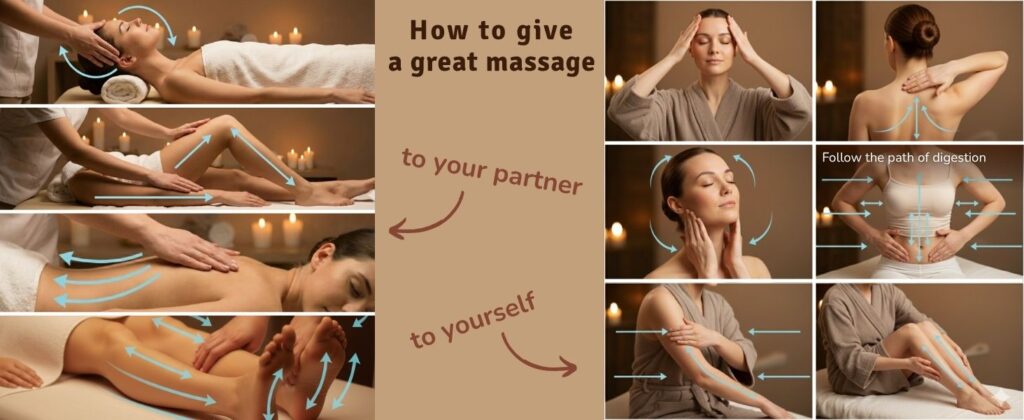
You don’t need to remember a sequence of named strokes. You need three basic moves and the willingness to slow down.
Minute 1–2: warm-up. Pour a 50-cent coin amount of oil into your palm, rub your hands together, then place them flat on the lower back. Glide both hands up along the back, out across the shoulders, and back down the sides. Long, slow strokes. Repeat for about two minutes. This is the “I’m here” signal that lets the receiver’s nervous system register the touch.
Minute 3–8: shoulders, neck, and upper back. This is where most desk workers hold tension, so this is where you’ll spend the most time. Use your thumbs in small circles along the muscles on either side of the spine (never on the spine itself — always to the sides). Work from the base of the skull down to the mid-back. When you find a knot, slow down on it for ten breaths rather than digging harder.
Minute 9–11: arms or lower back, depending on what they want. Either move down to the lower back with broad flat-palm circles, or lift each arm and work from wrist up to shoulder with long squeezes. Ask once if they have a preference, then commit to one or the other.
Minute 12: closing. Return to long, gliding strokes over the whole back. Get gradually lighter until you’re barely touching. End with both hands resting still on the shoulders for ten seconds. Then quietly: “your turn, take a minute.”
The receiver doesn’t jump up. They take a minute, then roll over and sit up slowly. Then you swap places.
The second person’s massage should be the same length and the same attention. This sounds obvious but it’s the most common failure point: the first massage is twenty minutes and beautiful, the second one is six minutes and rushed because everyone’s tired. If you can’t both do fifteen minutes properly tonight, both do ten. Even trades only.
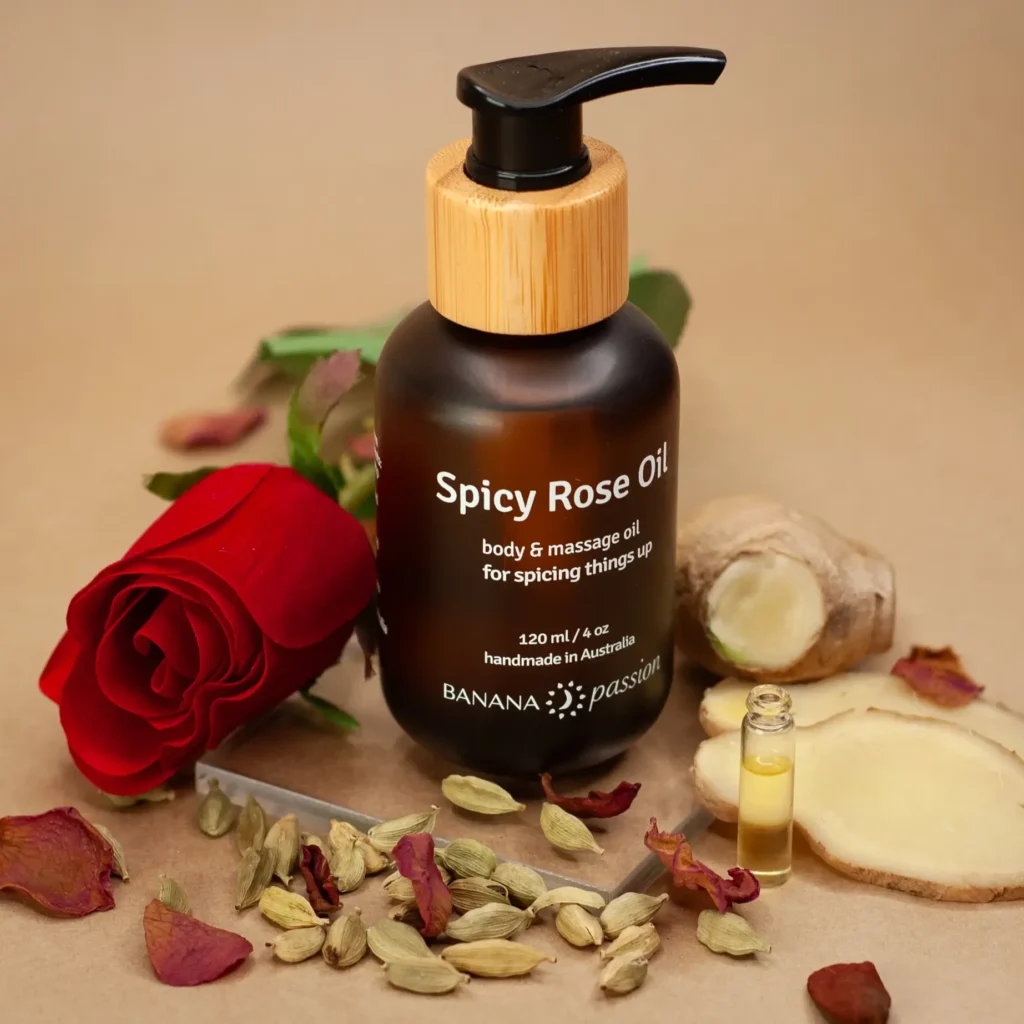
For couples specifically, a few things make a real difference.
A warm, sensual scent. Vanilla, sandalwood, rose, and warm spices tend to land best for couples, warm scent families are linked to intimacy and bonding in scent psychology research. Sharp scents (eucalyptus, peppermint) are great for sore muscles but kill the mood.
At Banana Passion we make three blends pitched at three different couple moods, all hand-blended in Australia, all formulated for skin-on-skin use:
A base that doesn’t sit heavy on the skin. All three blends use combinations of avocado, jojoba, fractionated coconut and other plant-derived carriers, light enough to absorb without leaving a film overnight, slow enough to give proper glide. Avoid anything heavy with mineral oil or paraffin (sits on the skin, harder to wash out).
Safe for intimate skin, but not a lubricant. Our massage oils are formulated to be safe on intimate skin if your massage transitions that way, meaning they won’t irritate sensitive areas the way some essential-oil-heavy products will. That’s different from being a personal lubricant. These oils aren’t designed or tested for use inside the body or as a sex lube. If you want a lube, use a product designed and labelled as one (water-based is the safest all-rounder). And remember: all oil-based products degrade latex condoms within sixty seconds, so don’t combine massage oil with condom use.
Not too much of it. A 50-cent coin amount per body section is plenty. Too much oil means hands slip rather than glide, and you can’t apply useful pressure.
Each blend uses two to five carrier oils chosen for skin feel, absorption rate and shelf life. The full ingredient lists are on each product page if you want to check for allergies before buying.
No. And the relationship gets richer when it doesn’t, at least sometimes.
This is the part most couples get wrong, especially early on. If every massage is foreplay, the massage stops being its own thing, it becomes a transaction one of you initiates when you want sex and the other one starts to feel mildly used. The receiver also can’t relax properly because part of their brain is tracking “is this leading somewhere?”
The cleanest fix is an explicit rule: at least half your massages don’t lead to sex. Both of you know this going in. The receiver can drop into the massage without managing what comes next, and the giver gives without performing.
When you do want a massage to lead to sex, name it before you start: “I’d love a massage that turns into something.” That removes ambiguity and lets the receiver match the energy.
The Gottman research on long-term relationships is unambiguous about this: physical affection that isn’t a transaction is one of the strongest predictors of relationship satisfaction. Massage is one of the easiest ways to build that into a relationship without it feeling clinical.
This is the hardest part of mutual massage and the thing that causes more silent frustration than any technique mistake.
Direction the receiver should give: specific, in the moment, no apology.
Direction the giver should ask for: once at the start, then trust the silence.
What to skip:
A useful rule: the receiver’s job is to direct in the moment, and the giver’s job is to follow without interpretation. If the receiver says “lighter,” the giver doesn’t ask why, they just go lighter.
There’s no scientifically correct answer, but the sweet spot for most couples is once a week, with shorter daily versions (a five-minute shoulder rub on the couch, foot pressure during a movie) layered in.
Once a week is frequent enough that the practice doesn’t feel like a special event, and infrequent enough that it doesn’t become a chore. Both partners know “Sunday night is massage night” and the anticipation itself is part of the bond.
Tactics that actually keep it going:
A few situations make this harder than the textbook version. Here’s how to handle them.
Stay clothed for the giving partner’s first few sessions if it helps. Use a sheet over everything except the area being worked on. Keep lights low. Don’t comment on bodies, focus on what they’re feeling, not how they look. If body-image issues are running deep, a few sessions with a counsellor or psychologist (the Australian Psychological Society Find-a-Psychologist tool is the standard reference) is more important than getting the massage routine right.
Massage can help muscular tension but won’t fix structural or systemic issues. For chronic conditions (fibromyalgia, MS, recent surgery, cancer treatment), check with the treating doctor before doing partner massage. For acute illness (cold, flu, infection), wait until you’re well. Light hand-holding or hair-stroking achieves much of the same connection benefit during these periods.
If one partner wants sex more than the other, mutual massage is one of the most useful tools available, but only if both of you agree it’s not always a path to sex. The higher-libido partner has to genuinely accept that. Once that’s settled, massage becomes a regular high-quality physical connection that both can enjoy without one feeling pressured and the other feeling rejected.
Not the first night. Repair the disagreement with words first. Massage as a “let’s just forget about it” workaround buries things that need to be aired. Once you’ve actually talked, a massage the next night is a beautiful way to physically signal you’re back on the same team.
A massage in the lounge room after the kids are asleep, with a waterproof blanket on the carpet and a single lamp on, works fine. You don’t need a dedicated space.
The “low-stakes, fully-clothed shoulder rub on the couch” version is the right starting point. It builds the habit of giving each other this kind of touch before you’re navigating logistics together. Don’t go to the full bedroom-with-oil version on date three; build to it over a few weeks.
Self-massage with the same oil you’d use together, at the same time, while on the phone. Sounds silly until you try it. The shared ritual closes some of the distance even when the physical contact is on hold.
Pulled from search data, customer emails, and the questions people ask AI assistants. Skim to the one you need.
No. At least half of your massages shouldn’t, by mutual agreement at the start. This protects the practice from becoming a sex transaction, lets the receiver actually relax, and — counter-intuitively — makes the massages that do lead to sex hotter because there’s no obligation either way.
Most “bad” partner massage isn’t about skill, it’s about uneven pressure, going too fast, or talking too much. All three are fixable with direct in-the-moment feedback (“a bit slower,” “softer,” “less talking”). If you’ve been together a while and the technique still grates, do five massages in a row giving live direction every minute. Most people improve dramatically in one or two sessions if they’re getting clear feedback.
Frame it as something you want to do together, not something you’re asking them to do for you. “Want to trade massages tonight?” works better than “Will you give me a massage?” The trade element removes the imbalance and most partners are happier giving when they know they’re also receiving.
Yes. Nothing in mutual massage is gender-specific. The 15-and-15 trade, the technique sequence, the communication advice, the oil choices, all apply equally regardless of the genders involved.
Normal, common, not a problem. Bodies respond to slow touch, that’s the whole point. If the rule for the session is “not leading to sex,” it doesn’t matter what either body does. You can name it lightly (“body’s having a moment, ignore it”) or just not mention it. Don’t apologise for it.
That’s up to you. Many couples start clothed, move to underwear, and only later to skin-on-skin. Naked is not required for the massage to work; oil applied directly to skin gives better glide, but a sheet over the unworked areas and oil only on bare skin where needed is a perfectly good compromise.
Fifteen minutes per person is the practical sweet spot. Less than ten minutes per side isn’t long enough for either nervous system to settle. More than twenty per side and most home givers’ hands get tired. Thirty minutes total is the dose-response number from the touch research.
Once a week with shorter daily versions (a five-minute shoulder rub, foot pressure during a movie) layered in is the sweet spot for most couples. The continuity matters more than the depth — a regular five minutes beats an occasional hour.
The receiver lies face-down on a firm bed with a waterproof blanket or towel underneath, head turned to one side or in a folded pillow. The giver kneels or sits beside them or straddles them on the bed (not putting weight down, just for hand position). A face cradle isn’t necessary; turning the head every few minutes is fine.
No, and that’s an important distinction. Our massage oils are formulated to be safe on intimate skin (meaning they won’t irritate sensitive areas if your massage transitions that way), but they are not personal lubricants. They aren’t designed or tested for use inside the body or as a sex lube. If you want a lube, use a product designed and labelled as one, water-based is the safest all-rounder, and it’s also condom-compatible. All oil-based products, including these, degrade latex condoms within sixty seconds, so don’t combine massage oil with condom use. Most couples keep one bottle of massage oil and one separate bottle of water-based lube in the bedside drawer.
Real. The 2022 Scientific Reports meta-analysis (137 studies) and the Gottman Institute’s long-term relationship research both point to non-sexual physical affection as one of the strongest predictors of relationship satisfaction. Couples massage is one of the cleanest ways to build that into a busy life.
Have the conversation outside the bedroom about why. Sometimes it’s sensory (overstimulated, tactile defensiveness), sometimes it’s body image, sometimes it’s a hangover from past experiences. The answer depends on the cause. The “low-stakes, fully-clothed shoulder rub on the couch” version is often the right entry point for partners who feel uncomfortable with prolonged touch — it’s contained, predictable, and easy to opt out of mid-way.
Generally, yes, giving a massage isn’t problematic in pregnancy. Receiving a massage in pregnancy is fine in most cases too, but avoid essential oil blends (use unscented carrier oil), don’t lie flat on your back after about twenty weeks, and check with your midwife or OB if you have a high-risk pregnancy. Always consult a medical professional.
Slow down and use firmer pressure on the ticklish area. Tickling usually happens with light, unpredictable touch; deliberate, firm pressure rarely tickles. If a specific spot is permanently off-limits (some people’s feet, some people’s ribs), just skip it.
Use lighter-scented oils, open a window after, and keep a waterproof blanket between oil and any porous surfaces. Most quality massage oils have a light enough scent that they dissipate within a few hours.
Yes, and these are often the most underrated parts. Scalp massage at the end of a session is many people’s favourite single thing. Ears (gently pressed and rolled between thumb and finger) and the back of the neck are densely innervated and create disproportionate relaxation for very little effort.
Communicate in the moment, every session. Even after years together, pressure preferences shift day to day based on sleep, hormones, stress, exercise. The receiver’s first job is to give pressure feedback in the first minute. The giver’s first job is to ask. Once at the start, then trust.
Instrumental, 60–80 BPM. Slower than that drags; faster pulls you out of the moment. Most “spa,” “sleep,” or “study” playlists on Spotify or Apple Music sit in this range. Avoid music with vocals or lyrics in a language either of you speaks — words pull the brain back into thinking mode.
For relaxation and connection, yes. For treatment of injuries, chronic pain, or musculoskeletal issues, no, see a registered remedial massage therapist via Massage & Myotherapy Australia. The two serve different purposes and most couples benefit from both: professional massage when something hurts, home couples massage for relationship and weekly stress relief.
Dim, not off. Off makes the giver less precise and the receiver more anxious about where the hands are going. A single bedside lamp or two candles is the sweet spot.
Laugh and keep going. Awkwardness fades within the first three or four sessions. The first few times you try anything new with a partner you’ve been with for years feels slightly weird; that’s not a sign you should stop, it’s a sign you’re doing something new.
Couples massage isn’t a special-occasion treat. It’s a low-cost, low-skill, weekly practice that gives both nervous systems a regular reset, builds non-sexual physical affection (one of the strongest predictors of long-term relationship satisfaction), and quietly holds the bond together in seasons when sex is on pause, when libidos are mismatched, or when life is generally too loud.
The kit costs less than a single dinner out. The technique can be learned in fifteen minutes. The “rule” — half your massages don’t lead to sex — protects the practice from becoming a transaction. The trade format keeps it equal. And the regularity matters more than any individual session.
Pick a night this week. A bottle of massage oil, a waterproof blanket over the bed, fifteen minutes each, phones in the other room. That’s the whole thing.
Browse our massage oil range — Australian-made, formulated for skin-on-skin use, with free Australian shipping on orders over AU$150.
Banana Passion is an Australian sexual wellness brand based in Wareemba, Sydney. We’ve been shipping massage oils, sensual balms, waterproof blankets, and novelty candles to Australian households since 2021. Got a couples-massage question this guide didn’t answer? Email info@bananapassion.com.au and we’ll add it.
